Changelog #17


M5 Max Support (Early Access)
Last week, our CEO, Hugo, teased that we were cooking something up on LinkedIn and today we are excited to announce early access for Apple M5 Max. Compared to M4 Max, Apple delivered up to 30% faster CPU performance and over 4x the GPU compute for AI workloads in the M5 Max. This means build times come down even further, and workloads that were hitting memory limits have more headroom.
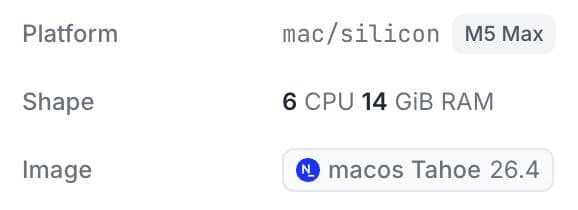
For most teams, the difference will be most noticeable on large monorepo builds, link-heavy Swift projects, and test suites that parallelize across cores. If you're already happy with M4 Max, you probably don't need to switch right now. If you're running into ceilings on build time or memory, M5 Max is worth trying.
We're rolling this out in early access while we scale capacity. Email support@namespace.so to get access.
Tailscale Magic DNS
The Tailscale integration now supports Magic DNS, which is Tailscale's feature for resolving devices on your tailnet by hostname rather than IP address.
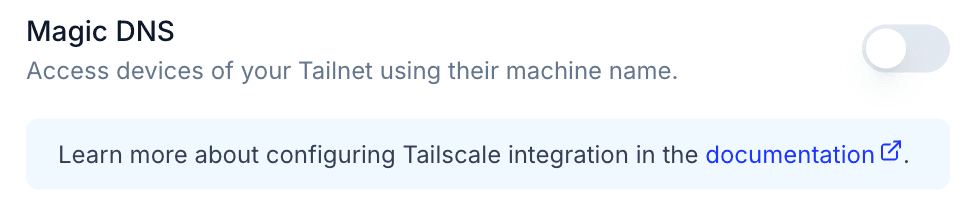
Without Magic DNS, connecting a CI job to private infrastructure over Tailscale means either hardcoding IPs or writing extra logic in your workflow to look up addresses. With Magic DNS enabled on the Namespace integration, jobs can refer to internal services the same way any other machine on your tailnet would, using the device's name.
Magic DNS can be enabled when configuring the Tailscale integration. See the Tailscale integration docs for details.
Nested Virtualization for Linux-on-Apple
Linux-on-Apple instances now have nested virtualization enabled, so jobs that use QEMU, Firecracker, libvirt, or similar tooling can run on the same instances as the rest of your pipeline. The same goes for integration tests that expect to be inside a VM, or release workflows that build and validate VM images.
There's nothing to configure; it's on by default for Linux-on-Apple instances.
Summary
M5 Max instances are available in early access, nested virtualization is now available on Linux-on-Apple, and the Tailscale integration now supports Magic DNS. See the full changelog for everything.