

Generated clients for other languages
Install a client for your language from the SDKs page, which covers Python, Rust, and more. These clients are generated from the published schema rather than maintained by Namespace, so they expose every procedure and message type without the conveniences of the maintained SDKs.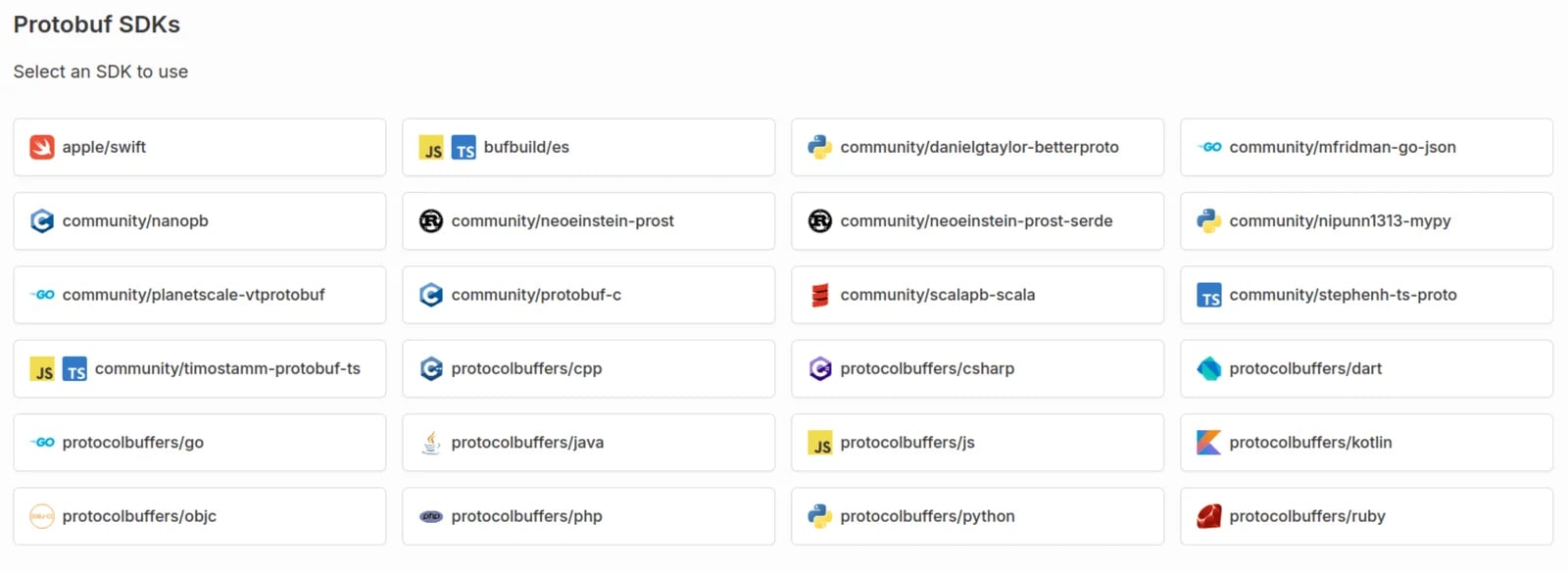
Some of the available clients
Endpoints
Namespace serves the API over gRPC and the Connect protocol. Which host you dial depends on the service family.
The schema holds more service families than this table lists, so confirm the endpoint on the service’s own page in the schema registry before you call it.
Regional resources exist in the region that created them, so a call must reach the endpoint for that region. From inside a Namespace instance,
NSC_ENDPOINT points at the Compute endpoint for the region the instance runs in.
Authentication
Every call carries a Namespace token in anAuthorization header:
Automated workloads
Configure federation so the workload exchanges its OpenID Connect identity for short-lived, scoped Namespace credentials, which avoids storing a long-lived shared secret in your CI system. Start with a trust relationship for the provider’s issuer and subject, then exchange the provider’s token:The command stores the credential where
nsc and the maintained SDKs look for it, rather than printing it. To obtain a token for raw HTTP calls, run the same exchange as an API call: TokenService.IssueTenantTokenWithOIDC authenticates with the OIDC token in the request and returns a bearer_token.Local development
Afternsc login, print a token for your workspace:
--output_to to write the token to a file instead. See nsc auth generate-dev-token.
Where federation is unavailable
Create a revokable token with an explicit scope and expiration, for CI systems without OIDC support or for automated scripts:Inside a Namespace workload
Workloads running on Namespace already receive a credential, so no exchange step is needed. The credential is a JSON file named byNSC_TOKEN_FILE, or /var/run/nsc/token.json when that variable is unset. Read the bearer_token field from it rather than passing the file contents:
Make a call
Connect serves each unary procedure as an HTTPPOST to /<proto package>.<Service>/<Method>, with the request message as the JSON body. Listing compute instances in the us region looks like this:
maxEntries is a 64-bit integer, which Protobuf JSON encodes as a string.
The response is the Protobuf JSON encoding of the procedure’s response message, so this call returns a ListInstancesResponse with an instances array and a paginationCursor. Field names, defaults, and semantics are described in the ComputeService reference.
Streaming procedures, such as
WaitInstance and StreamInstanceLogs, do not use this request shape. They rely on Connect’s streaming content type and envelope framing, so call them through a generated client unless you intend to implement the wire protocol yourself.grpcurl.
Errors
Failures carry a status code and a message. The codes are the standard gRPC and Connect set, and the schema registry documents which ones each procedure returns. The ones you are most likely to handle:IAM integration
To create and manage multiple workspaces programmatically, integrate with Namespace IAM oniam.namespaceapis.com. Namespace verifies tokens through trust relationships built on public-key cryptography and the OpenID Connect standard, rather than pre-shared keys, which are more easily compromised. See Federation for the setup on each provider.
Related documentation
SDKs
Maintained clients for TypeScript and Go.
Federation
Exchange an OIDC identity for Namespace credentials.
Examples
Working examples in Go, TypeScript, and Python.